How Digital marketing Works Every business needs customers. Every customer is online. That is why digital marketing matters.
But many people hear the term and feel confused. It just a social media? Is it about ads? Is it only for big companies?
No. Digital marketing is for everyone. And once you understand how it works, you will see just how powerful it is.
Let us break it down — simply and clearly.
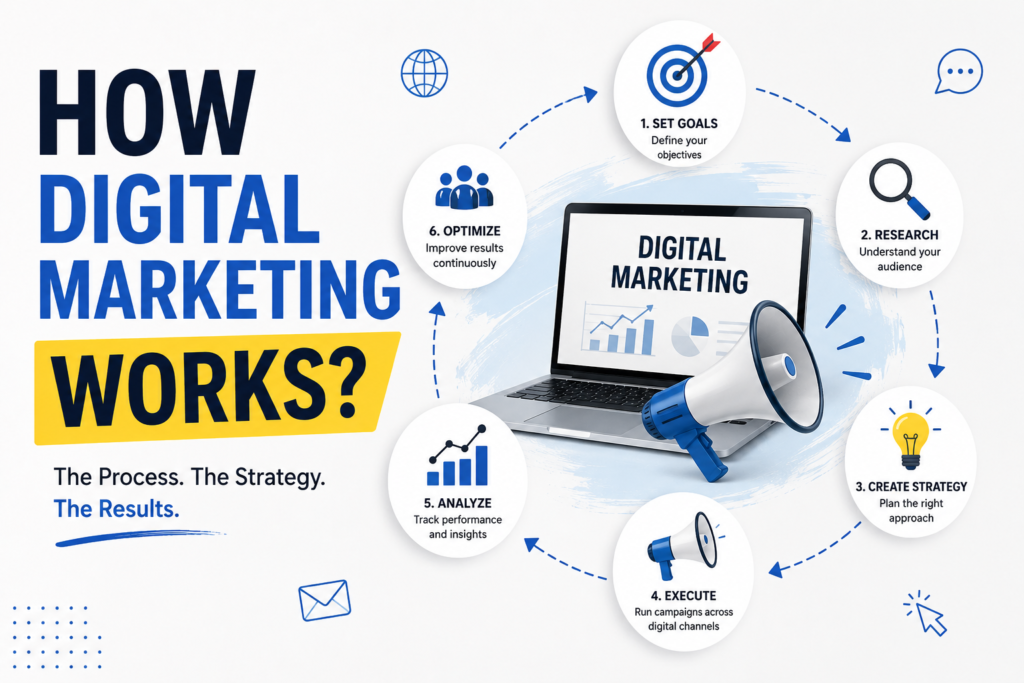
What Is Digital Marketing?
Digital marketing is promoting your business online.
It covers everything from your website to your social media pages. It includes emails, search engines, paid ads, and video content. Any way you reach a customer through a screen — that is digital marketing.
The goal is simple. Attract the right people. Turn them into customers. Keep them coming back.
Unlike traditional marketing — TV ads, billboards, newspaper — digital marketing is measurable. You can see exactly how many people clicked your ad. You know how many read your email. You track every step of the customer journey.
That is the real power of going digital.
How Digital Marketing Works 2026 ?
Before we talk about channels, understand this: customers do not buy instantly.
They follow a path. Marketers call it the customer journey. It has three main stages:
Awareness — The customer discovers your brand. They see a blog post, a social media ad, or a Google search result.
Consideration — They explore more. They read reviews, visit your website, compare you with competitors.
Decision — They trust you enough to buy.
Digital marketing touches all three stages. Different tools work at different stages. Good marketers use the right tool at the right time.
Search Engine Optimisation (SEO)
When someone types a question into Google, they get a list of results. Do you know who appears at the top? Websites that have done good SEO.
SEO stands for Search Engine Optimisation. It means making your website easier for Google to find and rank.
Here is how it works:
- You research the keywords your audience searches for
- You create helpful content around those keywords
- You make your website fast and easy to use
- You earn links from other trusted websites
Google then recognises your site as valuable. It pushes your pages higher in search results. More people see you. More people visit. More people buy.
SEO takes time. But it delivers long-term results without paying for every click.
Pay-Per-Click Advertising (PPC)
Want faster results? Use paid ads.
PPC stands for Pay-Per-Click. You create an ad. It appears on Google or social media. You only pay when someone clicks on it.
Google Ads is the most popular PPC platform. You bid on keywords. When someone searches that keyword, your ad appears at the top of the page. It looks just like an organic result — but it says “Sponsored.”
PPC works well for:
- New businesses that need traffic quickly
- Product launches
- Seasonal promotions
- Reaching a very specific audience
The key to PPC is targeting. You choose who sees your ad — their age, location, interests, and even their recent search behaviour. This means less waste and more results.
Social Media Marketing
Billions of people use social media every day. Facebook, Instagram, LinkedIn, YouTube, TikTok — your audience is already there.
Social media marketing means creating content on these platforms to build your brand and attract customers.
It works in two ways:
Organic social — You post content for free. You build followers. You engage with comments. You share valuable, entertaining, or educational content. Over time, people trust your brand.
Paid social — You run targeted ads. You pay to reach people who match your ideal customer profile. Even people who have never heard of you can see your brand.
The best social media strategy uses both. Organic builds loyalty. Paid drives growth.
Each platform works differently. Instagram is visual. LinkedIn is professional. TikTok is short and fast. Pick the platforms where your audience spends time.
Content Marketing
Content marketing is one of the most powerful digital strategies. It focuses on creating useful, relevant content that attracts your target audience.
Think blog posts, how-to guides, videos, infographics, podcasts, and case studies.
Here is why it works: people do not want to be sold to. They want to learn. They want to solve problems. When your content helps them, they trust you. When they trust you, they buy from you.
Content marketing also fuels SEO. Every blog post you publish is a new page Google can rank. The more helpful content you create, the more traffic you attract for free.
Good content answers real questions. It speaks in simple language. It gives genuine value before asking for anything in return.
Email Marketing
Email is not dead. In fact, it delivers one of the highest returns in all of digital marketing.
For every £1 spent on email marketing, businesses earn around £36 back on average. That is a remarkable number.
Here is how email marketing works:
You build a list of subscribers — people who have opted in to hear from you. Then you send them targeted messages. Newsletters, product updates, discount codes, helpful tips.
The best email marketers segment their lists. They send different messages to different groups based on behaviour and interests. A first-time visitor gets a welcome email. A repeat buyer gets a loyalty discount. Someone who abandoned their cart gets a reminder.
This level of personalisation drives clicks and conversions. It also builds a long-term relationship between your brand and your customers.
Influencer and Affiliate Marketing
You do not always have to market directly. Sometimes, other people do it for you.
Influencer marketing means partnering with people who already have an engaged audience. An influencer recommends your product. Their followers trust their opinion. Some of those followers become your customers.
This works especially well in fashion, beauty, fitness, food, and tech. Micro-influencers — those with 10,000 to 100,000 followers — often drive better results than celebrities because their audience is more engaged.
Affiliate marketing is similar but performance-based. Affiliates promote your product using a unique link. They earn a commission every time someone buys through that link. You only pay for actual results.
Both models extend your reach without spending on traditional advertising.
Analytics and Tracking
Here is what separates digital marketing from all other types of marketing: everything is trackable.
You can measure:
- How many people visited your website
- Where they came from
- Which pages they read
- How long they stayed
- What they clicked
- Whether they made a purchase
Tools like Google Analytics, Meta Ads Manager, and email dashboards give you this data in real time. You see what is working. You stop what is not. You improve constantly.
This data-driven approach means you do not waste money. You invest in what gets results.
How All the Channels Work Together
Here is a common mistake people make. They treat each channel separately.
They post on Instagram. They run Google Ads. They send a few emails. But none of it connects.
Smart digital marketing works as a system.
A customer finds your blog through Google. They read it and follow you on Instagram. They sign up for your email list. You send them a helpful guide. Then you offer a discount. They buy.
That is the system working. Each channel plays a role. SEO brings them in. Social media builds trust. Email converts them. Paid ads re-engage them if they leave.
When all your channels work together, your marketing becomes much more effective.
Why Digital Marketing Works for Every Business
Digital marketing is not just for global brands with massive budgets. A local bakery, a freelance designer, a small online store — all of them can use digital marketing to grow.
The tools are affordable. Many are free. The data helps you make smarter decisions. The targeting means you reach the right people without wasting money.
Whether you want more website visitors, more sales, or more brand awareness, digital marketing has a path to get you there.
Where to Start
Feeling overwhelmed? Start with one channel.
If your audience searches for your product on Google, start with SEO or PPC. If your audience is on Instagram, start with social media. If you already have customers, start with email marketing.
Learn that channel well. Get results. Then expand.
Digital marketing rewards consistency and curiosity. The more you test, learn, and improve, the better your results will get.
The online world is not going anywhere. And neither is digital marketing. The sooner you start, the sooner your business grows.
Read More – Can I Do Digital Marketing Course After 12th?
Published on Valuekartt | Digital Marketing Insights
