How Digital Marketing Is Different from Traditional Marketing is an important part of every business. Without marketing, customers may never learn about a company’s products or services. For many years, businesses used traditional marketing methods such as newspapers, magazines, radio, television, and billboards to reach customers. These methods helped companies build brand awareness and increase sales.
However, the rise of the internet has changed the marketing world. Today, businesses can reach customers through websites, search engines, social media platforms, email campaigns, and online advertisements. This modern approach is known as digital marketing.
Many business owners often ask an important question: How is digital marketing different from traditional marketing?
Both methods aim to promote products and attract customers. However, they work in very different ways. Understanding these differences can help businesses choose the right marketing strategy for their goals.
In this guide, you will learn the major differences between digital marketing and traditional marketing and why digital marketing has become so important in today’s business environment.
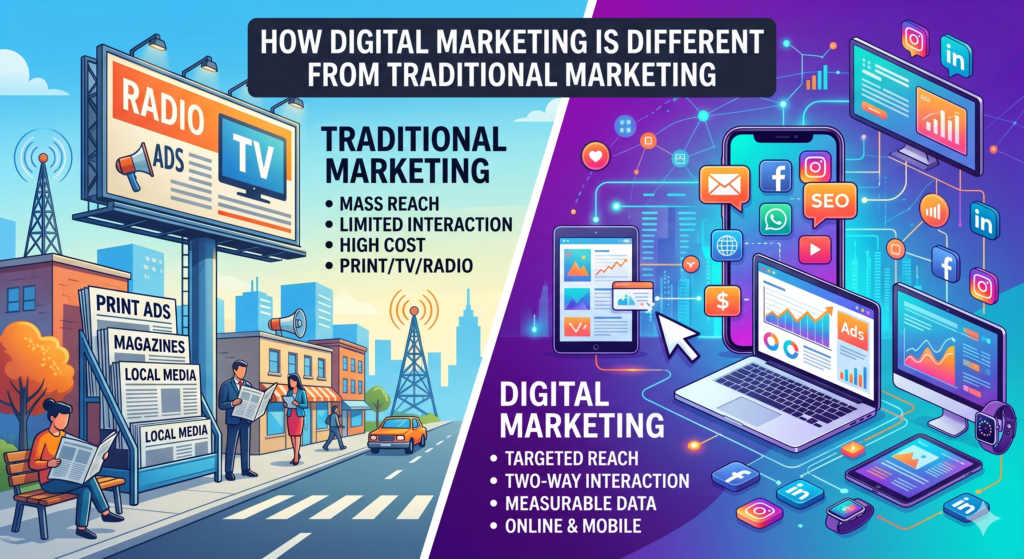
What Is Traditional Marketing?
Traditional marketing refers to promotional methods that existed before the internet became popular.
These methods include:
- Television advertisements
- Radio commercials
- Newspaper advertisements
- Magazine advertisements
- Flyers and brochures
- Direct mail
- Billboards
- Trade shows
Traditional marketing focuses on reaching audiences through offline channels.
For many decades, these methods were the primary way businesses promoted their products and services.
Large brands invested heavily in television and print advertising to attract customers.
Traditional marketing still exists today, but businesses now have additional options through digital marketing.
What Is Digital Marketing?
Digital marketing involves promoting products and services through online channels.
These channels include:
- Search engines
- Websites
- Social media platforms
- Email marketing
- Mobile apps
- Online advertisements
- Video platforms
Digital marketing allows businesses to connect with customers through the internet.
It offers advanced targeting, real-time tracking, and greater flexibility compared to traditional methods.
Today, businesses of all sizes use digital marketing to increase visibility, generate leads, and grow sales.
How Digital Marketing Is Different from Traditional Marketing
One of the biggest differences between digital marketing and traditional marketing is the communication channel.
Traditional marketing uses offline channels.
Examples include:
- Television
- Radio
- Newspapers
- Billboards
Digital marketing uses online channels.
Examples include:
- YouTube
- Websites
Since more people spend time online, digital channels provide businesses with new opportunities to connect with potential customers.
Difference 2: Audience Reach
Traditional marketing often targets a broad audience.
For example, a television commercial reaches many viewers regardless of their interests.
Some viewers may be interested in the product, while others may not.
Digital marketing allows businesses to target specific audiences.
Marketers can target users based on:
- Age
- Gender
- Location
- Interests
- Occupation
- Online behavior
This precise targeting improves marketing efficiency and reduces wasted spending.
Businesses can focus their efforts on people who are most likely to become customers.
Difference 3: Cost of Marketing
Marketing budgets play an important role in business growth.
Traditional marketing can be expensive.
Television advertisements, newspaper placements, and billboards often require significant investment.
Small businesses may struggle to afford these methods.
Digital marketing is generally more affordable.
Businesses can start with small budgets and increase spending as results improve.
For example:
- Social media marketing can begin with little cost.
- SEO focuses on organic traffic.
- Email marketing requires minimal investment.
This affordability makes digital marketing accessible to businesses of all sizes.
Difference 4: Measuring Results
One major challenge with traditional marketing is tracking performance.
A business may run a newspaper advertisement but struggle to determine how many customers came from that ad.
Measuring results often involves guesswork.
Digital marketing provides detailed performance data.
Businesses can track:
- Website visitors
- Clicks
- Conversions
- Sales
- Leads
- Engagement rates
Analytics tools provide real-time information.
This helps businesses understand what works and what needs improvement.
Accurate measurement leads to better decision-making.
Difference 5: Speed of Results
Traditional marketing campaigns often require significant preparation.
Designing, printing, and distributing advertisements can take time.
Making changes may also be difficult.
Digital marketing offers greater speed and flexibility.
Businesses can:
- Launch campaigns quickly
- Update advertisements instantly
- Adjust targeting in real time
For example, a Google Ads campaign can begin generating traffic within hours.
This flexibility allows businesses to respond quickly to market changes.
Difference 6: Customer Interaction
Traditional marketing typically provides one-way communication.
Businesses send messages to customers through advertisements.
Customer feedback is often delayed or limited.
Digital marketing encourages two-way communication.
Customers can:
- Comment on posts
- Send messages
- Leave reviews
- Participate in discussions
Businesses can respond immediately.
This interaction strengthens relationships and improves customer satisfaction.
Difference 7: Personalization
Modern customers expect personalized experiences.
Traditional marketing usually delivers the same message to everyone.
For example, a television advertisement appears identical for all viewers.
Digital marketing allows businesses to personalize content.
Companies can create customized messages based on:
- User behavior
- Purchase history
- Interests
- Demographics
Personalization improves engagement and increases conversion rates.
Customers often respond better to content that feels relevant to their needs.
Difference 8: Geographic Limitations
Traditional marketing often focuses on specific geographic areas.
A local newspaper advertisement primarily reaches local readers.
A billboard only reaches people who pass by that location.
Digital marketing removes many geographic barriers.
Businesses can reach customers worldwide through:
- Websites
- Social media
- Search engines
Even small businesses can attract international audiences.
This global reach creates significant growth opportunities.
Difference 9: Campaign Flexibility
Traditional marketing campaigns are often difficult to modify after launch.
Changing a printed advertisement may require additional costs and time.
Digital marketing campaigns can be adjusted instantly.
Businesses can modify:
- Advertisements
- Keywords
- Landing pages
- Budgets
- Target audiences
This flexibility improves campaign performance and reduces risk.
Marketers can optimize campaigns based on real-time data.
Difference 10: Customer Targeting
Traditional marketing relies on broad audience exposure.
Digital marketing focuses on precise targeting.
For example, a fitness business can target:
- Gym enthusiasts
- Health-conscious consumers
- People interested in weight loss
This targeted approach increases efficiency and improves return on investment.
Businesses spend less money reaching irrelevant audiences.
Difference 11: Long-Term Value
Traditional marketing often produces short-term results.
Once a newspaper advertisement disappears, its impact ends.
Digital marketing can provide long-term value.
For example:
- SEO content can attract traffic for years.
- Blog articles continue generating visitors.
- Email lists remain valuable marketing assets.
These long-term benefits improve marketing sustainability.
Businesses continue receiving value from past efforts.
Difference 12: Data and Analytics
Data plays a critical role in modern marketing.
Traditional marketing provides limited data.
Digital marketing offers detailed insights into customer behavior.
Businesses can analyze:
- Traffic sources
- User actions
- Conversion paths
- Engagement levels
These insights help marketers improve performance and maximize results.
Data-driven marketing is one of the biggest advantages of digital marketing.
Difference 13: Mobile Accessibility
Mobile devices have changed consumer behavior.
People use smartphones to search, shop, and communicate.
Traditional marketing cannot fully adapt to mobile usage.
Digital marketing is designed for mobile audiences.
Businesses can reach customers through:
- Mobile websites
- Social media apps
- Mobile advertisements
- Email campaigns
Mobile accessibility increases customer convenience and engagement.
Difference 14: Lead Generation
Generating leads is essential for business growth.
Traditional marketing often relies on customers taking action independently.
Digital marketing provides multiple lead generation tools.
Examples include:
- Contact forms
- Landing pages
- Lead magnets
- Email subscriptions
- Online consultations
These tools help businesses collect customer information and nurture prospects.
This improves conversion opportunities.
Difference 15: Return on Investment
Return on investment is a key factor for every business.
Traditional marketing often requires significant spending with uncertain results.
Digital marketing provides clearer ROI measurement.
Businesses can calculate:
- Cost per click
- Cost per lead
- Cost per acquisition
- Revenue generated
This transparency helps businesses allocate budgets more effectively.
Better ROI often leads to stronger business growth.
Advantages of Traditional Marketing
Although digital marketing dominates today’s landscape, traditional marketing still offers benefits.
Advantages include:
- Strong local visibility
- Brand recognition
- Credibility among certain audiences
- Effective mass-market exposure
Some industries still benefit from traditional advertising channels.
Television and radio remain powerful for reaching large audiences.
Advantages of Digital Marketing
Digital marketing offers several important benefits.
These include:
Lower Costs
Businesses can market effectively with smaller budgets.
Better Targeting
Campaigns reach the right audience.
Real-Time Tracking
Results are measurable and transparent.
Global Reach
Businesses can attract customers worldwide.
Higher Engagement
Customers can interact directly with brands.
Greater Flexibility
Campaigns can be adjusted quickly.
These advantages make digital marketing highly attractive for modern businesses.
Which Marketing Method Is Better?
The answer depends on business goals.
Traditional marketing can still be effective for certain campaigns.
However, digital marketing offers greater flexibility, affordability, and measurable results.
Many businesses combine both approaches.
For example:
- A company may run television advertisements while also investing in SEO.
- A local business may use flyers alongside social media marketing.
Combining strategies often creates stronger results.
However, digital marketing typically provides better value for small and medium-sized businesses.
The Future of Marketing
The future of marketing is becoming increasingly digital.
Consumer behavior continues shifting online.
Businesses now rely on:
- Search engines
- Social media
- E-commerce platforms
- Mobile applications
Emerging technologies such as artificial intelligence and marketing automation are further expanding digital marketing opportunities.
Companies that embrace digital marketing will be better positioned for future growth.
Conclusion
Digital marketing and traditional marketing share the same goal: attracting customers and increasing sales. However, they differ in many important ways.
Traditional marketing relies on offline channels such as television, radio, newspapers, and billboards. Digital marketing uses online platforms such as websites, search engines, social media, and email.
Digital marketing offers better targeting, lower costs, real-time tracking, greater flexibility, and stronger customer engagement. It also provides long-term value and global reach.
While traditional marketing still has its place, digital marketing has become the preferred choice for many businesses. Its ability to connect with the right audience, measure performance, and adapt quickly makes it one of the most powerful marketing tools available today.
Businesses that understand these differences can make smarter marketing decisions and achieve greater success in the digital age.
Read More – How Does Digital Marketing Work Step by Step? A Complete Beginner’s Guide
