Digital marketing has become one of the most effective ways to grow a business. Today, customers spend a large part of their time online. They search for products on Google, browse social media platforms, watch videos, and read blogs before making a purchase.
Because of this shift, businesses use digital marketing to attract customers and increase sales. However, many beginners still ask one common question: How does digital marketing work step by step?
The answer is simple. Digital marketing follows a process. Businesses identify their target audience, create marketing strategies, attract visitors, generate leads, and convert those leads into customers.
In this guide, you will learn exactly how digital marketing works from start to finish. Whether you own a business or want to start a digital marketing career, understanding these steps will help you succeed.
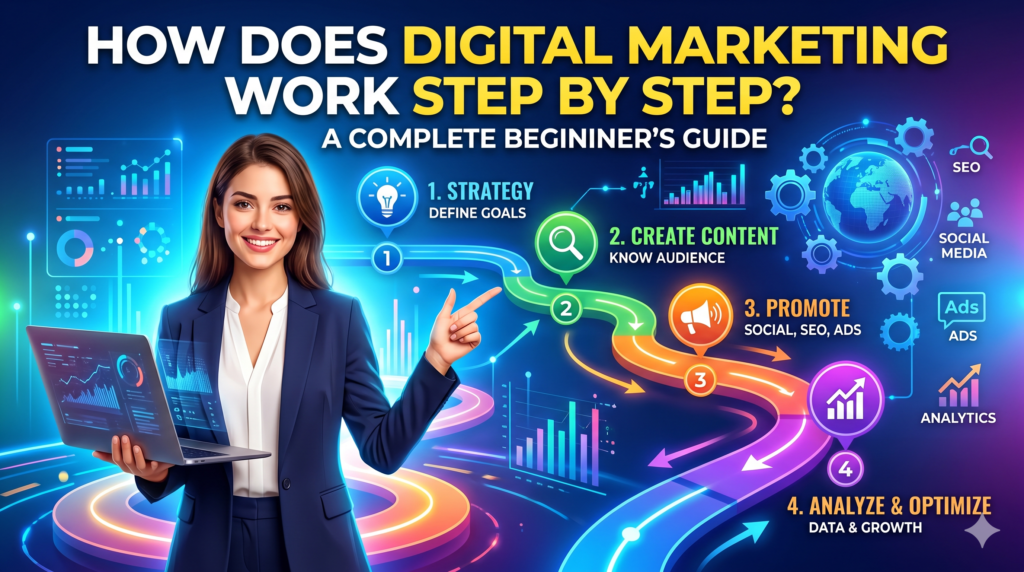
How Does Digital Marketing Work Step by Step? A Complete Beginner’s Guide
Digital marketing is the process of promoting products, services, or brands using online channels.
These channels include:
- Search engines
- Social media platforms
- Websites
- Email marketing
- Online advertising
- Mobile applications
The goal of digital marketing is to connect businesses with potential customers online.
Unlike traditional marketing, digital marketing allows businesses to target specific audiences and track results in real time.
Step 1: Define Your Marketing Goals
Every successful digital marketing campaign starts with a clear goal.
Without goals, it becomes difficult to measure success.
Common digital marketing goals include:
- Increasing website traffic
- Generating leads
- Growing sales
- Building brand awareness
- Increasing social media followers
- Improving customer engagement
Businesses should identify what they want to achieve before starting any marketing activity.
Clear goals create a strong foundation for future success.
Step 2: Understand Your Target Audience
The next step is understanding your audience.
A business cannot market effectively without knowing who its customers are.
Marketers study factors such as:
- Age
- Gender
- Location
- Interests
- Income level
- Buying behavior
This information helps businesses create messages that connect with the right people.
For example, a fitness brand targets different customers than a software company.
Understanding your audience improves marketing performance.
Step 3: Research the Market and Competitors
Before launching a campaign, businesses study their industry and competitors.
Competitor research helps identify:
- Strengths
- Weaknesses
- Opportunities
- Market trends
Businesses analyze competitor websites, social media accounts, advertisements, and content.
This research helps create better marketing strategies.
Learning from successful competitors can save time and improve results.
Step 4: Build a Professional Website
A website serves as the center of most digital marketing activities.
It is often the first place customers visit.
A professional website should:
- Load quickly
- Look professional
- Work on mobile devices
- Be easy to navigate
- Provide useful information
The website should clearly explain products or services.
It should also encourage visitors to take action.
Examples include:
- Making a purchase
- Filling out a form
- Calling the business
- Subscribing to a newsletter
A strong website improves conversions and customer trust.
Step 5: Perform Keyword Research
Keyword research is a critical step in digital marketing.
Keywords are the words people type into search engines.
Businesses need to know what their target audience searches for online.
For example:
- Digital marketing services
- Best SEO company
- Local plumber near me
- Online fitness classes
Marketers use keyword research tools to identify valuable search terms.
These keywords guide content creation and SEO efforts.
Choosing the right keywords helps attract relevant traffic.
Step 6: Optimize the Website for SEO
Search Engine Optimization helps websites appear on Google and other search engines.
SEO increases organic traffic without paying for ads.
SEO includes:
On-Page SEO
This involves optimizing:
- Page titles
- Meta descriptions
- Headings
- Content
- Images
Technical SEO
Technical SEO focuses on:
- Website speed
- Mobile-friendliness
- Site structure
- Security
Off-Page SEO
Off-page SEO includes:
- Link building
- Brand mentions
- Online authority building
Good SEO improves visibility and attracts potential customers.
Step 7: Create Valuable Content
Content is one of the most important parts of digital marketing.
Content helps businesses educate, inform, and attract customers.
Examples include:
- Blog posts
- Videos
- Guides
- Case studies
- Infographics
- Podcasts
Quality content solves problems and answers customer questions.
When people find helpful information, they begin to trust the business.
Content also supports SEO by targeting important keywords.
Step 8: Publish Content Regularly
Creating content is not enough.
Businesses must publish content consistently.
Regular publishing keeps websites fresh and active.
Search engines prefer websites that update content regularly.
Consistent publishing also helps businesses:
- Increase visibility
- Build authority
- Attract more traffic
Many successful businesses follow content calendars to maintain consistency.
Step 9: Use Social Media Marketing
Social media platforms help businesses connect with customers.
Popular platforms include:
- X
- YouTube
Businesses share content, engage with followers, and promote products.
Social media marketing helps:
- Build brand awareness
- Increase engagement
- Drive website traffic
Regular interaction creates stronger customer relationships.
Step 10: Run Paid Advertising Campaigns
Paid advertising provides faster results than organic marketing.
Businesses use platforms such as:
- Google Ads
- Facebook Ads
- Instagram Ads
- LinkedIn Ads
Paid campaigns target specific audiences based on:
- Location
- Interests
- Demographics
- Online behavior
Advertising helps businesses generate traffic, leads, and sales quickly.
Many companies combine paid ads with SEO for maximum results.
Step 11: Capture Leads
Not every visitor becomes a customer immediately.
Many people need time before making a purchase.
Businesses collect leads to stay connected with potential customers.
Common lead generation methods include:
- Contact forms
- Newsletter signups
- Free downloads
- Webinars
- Free consultations
Lead generation helps businesses build relationships with prospects.
These prospects can later become paying customers.
Step 12: Use Email Marketing
Email marketing helps nurture leads and maintain customer relationships.
Businesses send emails containing:
- Promotions
- Newsletters
- Educational content
- Product updates
Email marketing keeps the business in front of customers.
It encourages repeat visits and future purchases.
Many businesses generate significant revenue through email campaigns.
Step 13: Build Trust and Authority
Trust is essential in digital marketing.
Customers often research businesses before buying.
Businesses build trust through:
- Helpful content
- Positive reviews
- Testimonials
- Case studies
- Professional branding
The more trust a business earns, the easier it becomes to convert visitors into customers.
Authority also improves long-term marketing success.
Step 14: Convert Leads into Customers
The next step is conversion.
A conversion happens when a visitor takes a desired action.
Examples include:
- Buying a product
- Scheduling a consultation
- Requesting a quote
- Registering for a service
Businesses improve conversions through:
- Clear calls to action
- Strong offers
- User-friendly websites
- Trust-building elements
Higher conversion rates increase revenue without increasing traffic.
Step 15: Analyze Marketing Performance
One of the biggest advantages of digital marketing is measurement.
Businesses track performance using analytics tools.
Important metrics include:
- Website traffic
- Bounce rate
- Conversion rate
- Cost per lead
- Return on investment
Analytics help businesses understand what works and what does not.
This information supports smarter decision-making.
Step 16: Improve and Optimize Campaigns
Digital marketing is an ongoing process.
Successful marketers continuously improve campaigns.
They test:
- Headlines
- Landing pages
- Advertisements
- Email campaigns
- Content formats
Small improvements can produce significant results over time.
Optimization helps maximize marketing performance.
Step 17: Retain Existing Customers
Many businesses focus only on finding new customers.
However, retaining existing customers is often more profitable.
Customer retention strategies include:
- Email marketing
- Loyalty programs
- Personalized offers
- Excellent customer service
Happy customers often become repeat buyers.
They may also recommend the business to others.
This creates additional growth opportunities.
Step 18: Scale Successful Strategies
Once a marketing strategy produces results, businesses can scale it.
Scaling may involve:
- Increasing advertising budgets
- Publishing more content
- Expanding into new markets
- Launching additional campaigns
Growth becomes easier when businesses understand what works.
Scaling allows companies to increase revenue efficiently.
Common Digital Marketing Channels Working Together
Digital marketing works best when multiple channels support each other.
For example:
SEO attracts organic traffic.
Content marketing provides valuable information.
Social media promotes content.
Email marketing nurtures leads.
Paid advertising generates fast results.
Together, these channels create a complete marketing system.
This integrated approach increases effectiveness.
Benefits of Digital Marketing
Digital marketing offers many advantages:
Cost Effective
Businesses can start with small budgets.
Targeted Marketing
Campaigns reach the right audience.
Measurable Results
Performance can be tracked accurately.
Global Reach
Businesses can reach customers worldwide.
Better Customer Relationships
Online communication improves engagement.
Long-Term Growth
SEO and content marketing create lasting benefits.
These advantages make digital marketing essential for modern businesses.
Conclusion
Digital marketing works through a step-by-step process. Businesses start by setting goals and understanding their audience. They build websites, perform keyword research, optimize for SEO, create content, and promote their brand through social media and advertising.
The process continues with lead generation, email marketing, conversion optimization, and performance analysis. Each step plays an important role in attracting customers and increasing revenue.
When done correctly, digital marketing creates a system that consistently generates traffic, leads, and sales. It helps businesses grow, compete, and succeed in an increasingly digital world.
Whether you are a business owner, freelancer, or aspiring marketer, understanding how digital marketing works step by step can help you build a strong online presence and achieve long-term success.
Read More – Who Is a Digital Marketing Analyst? A Complete Guide to This Growing Career 2026
